

24 June 2024, Dubai, United Arab Emirates: When an electronics engineer from Heriot-Watt University spent three nights caring for her unwell son, she was struck by an idea that could soon revolutionise healthcare for babies in the home.
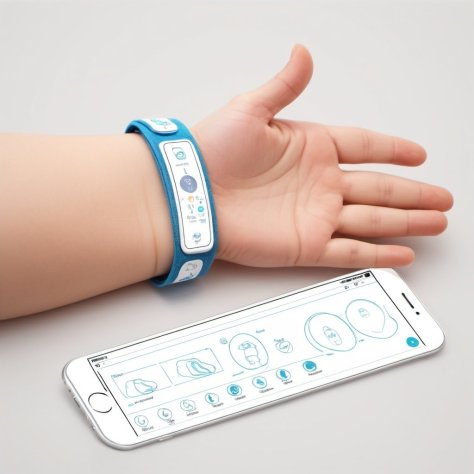
Dr Rula Sharqi, a lecturer at the University’s Dubai campus, has co-developed what is believed to be the world’s first ‘smart baby wristband’ capable of round-the-clock monitoring of a child’s vital signs with the ability to send text alerts and, in extreme cases, raise the alarm with emergency services.
She has spent the last 12 months working on the LittleGard project alongside fourth-year robotics engineering student, Nakhul Kalaivanan, who joined as part of his final year coursework.
After successfully building a working prototype, the pair are now willing to offer their idea for free to an industry partner with the capabilities of bringing the invention to market.
Dr Sharqi, an MIT-trained associate professor from the University’s School of Engineering and Physical Sciences, said: “We really believe in this product and its potential to save lives.
“Uncontrolled fevers account for the highest number of fatalities in infants so it’s a very serious problem.
“That’s why we are happy to give away our work for free to a company that has the knowledge and passion to bring this to market.”
Inspiration for the smart wristband came in 2018 when Dr Sharqi, a single-mother, was caring for her two-year-old son Joseph who was suffering from a fever.
Frequent trips to and from Joseph’s room to check his temperature left Dr Sharqi ‘drained and exhausted’.
She explains: “A baby’s fever often worsens at night because everyone’s body temperature naturally rises in the evening. This circadian rhythm, which regulates our body temperature throughout the day, causes temperatures to peak in the late afternoon and evening. As a result, any existing fever can seem more severe during these hours, making night-time monitoring particularly important for ensuring your baby’s well-being.
“But this can be exhausting for the parents, who often lose sleep.
“It was through my own terrible experience that I had the idea for a device capable of notifying me via text message, when my child’s temperature had risen beyond or below a safe level.”
The wristband monitors body temperature, oxygen levels and pulse rate through a sequence of advanced nano sensors. While similar products are available, the smart wristband is thought to be the first that can send monitoring alerts direct to parents, carers, medical professionals and emergency services.
It is fixed to a baby’s skin using a rubber material similar to that found in an Apple watch, helping to provide accurate readings. It is also wireless and powered by a rechargeable battery that is expected to last around six-months between charges.
When vital readings breach a safe limit, an email and/or text is automatically sent to parents via an app. There is also the option to issue the same alert to a family doctor to ensure the health authorities receive real-time information in the event medical attention is required.
Nakhul Kalaivanan is in his final year studying for a BEng (Hons) in Robotics Autonomous and Interactive Systems. He said: “With our wristband design, there won’t be any false readings as the sensors are placed directly onto the skin.
“It’s also a safe option as the device is battery powered and won’t overheat. We have used advanced sensors incorporated into our design, and have built-in safeguards so that a message can always be sent in the event WiFi temporarily drops.
“Besides monitoring vital signs, this device has the unique feature of sending alarm SMS alerts to parents and even directly to 911 in case of emergencies. This ensures immediate response and support, providing an extra layer of security for the baby’s health and safety.”
Dr Sharqi’s mother was one of the first female engineering graduates in the Arab world.
Now, following in her footsteps, Dr Sharqi hopes her work at the University will empower other women to consider engineering as a career.
She said: “My mother inspired me to enter the field of engineering and specialise in teaching in the School of Engineering and Physical Sciences. Through being involved in projects, such as this one, I hope I can inspire the new generation to apply for an engineering degree.”
Companies interested in finding out more about the product can contact Dr Sharqi via: [email protected]
–Ends–
About Heriot-Watt University Dubai
As the first British university to set up a campus in Dubai in 2005, Heriot-Watt University Dubai has established itself as a pioneer in the higher education market in the UAE. The University’s reputation for world-class teaching and practical, leading-edge research combined with its strong links to business and industry, has seen it attract a thriving population of undergraduate and postgraduate students. It offers an extensive range of programmes and disciplines, spanning postgraduate and undergraduate courses. Heriot-Watt graduates are highly employable and sought after by the best organisations worldwide, with over 90% in graduate level jobs or further study within six months of graduation.
For more information, please visit https://www.hw.ac.uk/dubai.htm.