


Smart lights have gotten pretty good over the years, letting you change colors, set schedules, and control almost every light in your house from a phone. Those are useful features, for sure, but what if you just want to dim your living room lights without pulling out your phone, finding the right app, and messing around with an on-screen slider?
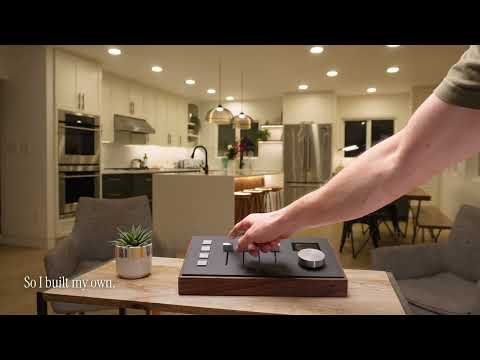
A Seattle-based hardware studio called Sacrebleu has created a lighting console called the F4 that brings back physical sliders and knobs for controlling smart lights. It looks like something from an old recording studio, and at $1,700, it probably costs more than all the lights in your living room combined.
The idea came from founder Alex Dufetel, who originally built one for his own house. After posting a video of it in September, his creation attracted around two million views across social media. Now he’s turning it into an actual product.
Four sliders that have a trick of their own
Using the F4 is pretty much what you’d expect from a miniature mixing desk. There are four motorized faders for controlling individual lights or groups of lights, and a large aluminum knob for adjusting the brightness of an entire room.
The unusual part is that those sliders can move on their own. If someone changes the brightness using a phone or a wall switch, the corresponding fader physically moves to match the setting. Press the knob to switch between rooms, and all four faders move to their new positions.
The device supports up to 16 rooms, and also has four preset keys and a 2.4-inch touchscreen. It works directly with Philips Hue, Lutron Caséta, and Sonos, while other smart lights and speakers can be connected through Home Assistant.


Old-school controls aren’t cheap
The F4 has a solid walnut body and machined aluminum controls, taking inspiration from 1970s hi-fi equipment. It’s also part of a growing interest in analog-style gadgets, as people start missing the physical buttons that touchscreens have replaced.
If you’re willing to spend $1,700 on controlling your lights, you can pre-order one with a refundable $50 deposit. The first 20 units at $1,600 were already reserved, and the next batch of 100 is expected to start shipping in the second quarter of 2027. For now, pre-orders are only available in the US and Canada, with an international waitlist for customers in other countries.