
Situated at the crossroads of global commerce, the GCC is tied to one of the world’s most important trade corridors, the Red Sea, which carries 12% of global trade. Regional economies are diversifying, strengthening their role in international supply chains and investing in advanced manufacturing and distribution zones. In turn, warehouse operators face mounting pressure to increase speed, resilience, and efficiency. Against these structural shifts, Swisslog highlights five warehouse challenges that automation is positioned to solve across MENA by 2026.
1. Labour shortages and rising costs
Warehouse processes such as picking and palletising can account for up to 60% of operational costs, with labour representing more than half of total warehouse expenditure. In high-demand logistics corridors, large turnover in manual roles and increasing wage expectations are intensifying pressure on operators to do more with fewer people.
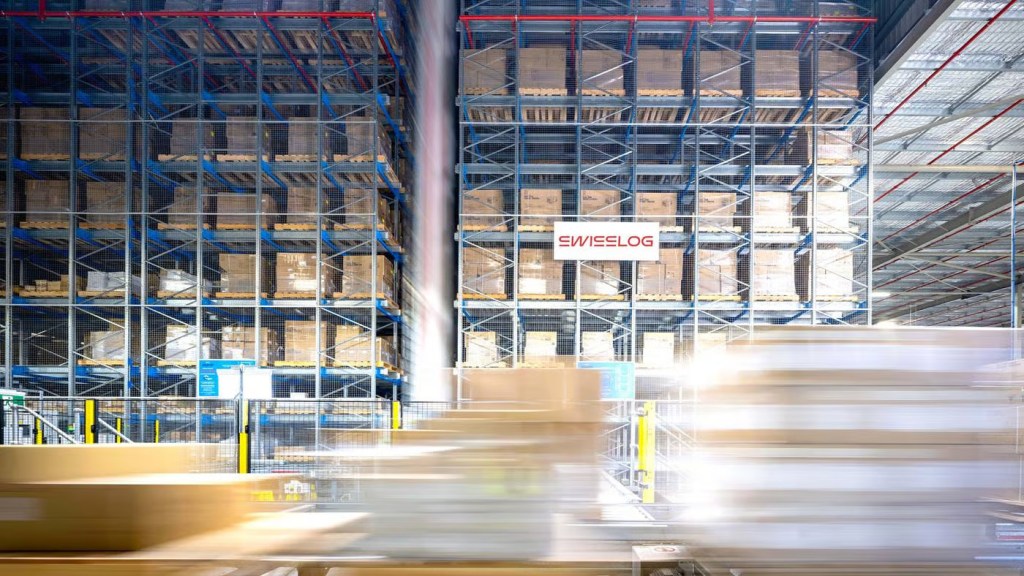
High-density robotic systems, such as AutoStore, can perform the work of four or five manual pickers with 99% accuracy. Across the region, similar goods-to-person and mobile robotic solutions are reducing dependency on seasonal labour and lowering error rates that lead to costly returns. By redesigning workflows around automation, operators are shifting talent into higher-value supervisory and technical roles while protecting margins from escalating labour costs.
2. E-commerce growth and peak volatility
E-commerce in MENA continues to expand rapidly, with the regional market projected to reach AED183.6 billion by 2028. Major peak events such as White Friday, 11.11, and Eid create demand spikes that manual operations cannot absorb through hiring alone. Robotics and automated storage and retrieval systems are expected to manage up to half of all orders in leading grocery and e-commerce environments, with fulfilment times projected to reduce from several hours to 30 minutes by 2028.
Integrated omnichannel facilities allow retailers to combine store replenishment and direct-to-consumer fulfilment within a single inventory pool. Shuttle systems and automated sortation enable dynamic allocation of stock between channels, while advanced warehouse control platforms synchronise robotics, manual workstations, and packing lines in real time. This allows operators to scale throughput during peaks without duplicating infrastructure.
3. Space constraints and rising industrial rents
Warehouse space near ports, airports, and major urban centres like Dubai and Riyadh is scarce and expensive. Here, optimising cubic capacity rather than expanding square metres is a competitive advantage. Automated storage and retrieval systems can maximise floor space utilisation by up to 85%, while compact grid-based and shuttle technologies allow operators to store up to four times more inventory than conventional racking within the same footprint. Increased density also reduces travel distances for both people and robots, boosting throughput and improving accuracy.
Extending the life of an existing facility through vertical and high-density storage offers a more viable financial path than relocation or greenfield construction.
4. Food security and cold chain resilience
Governments are investing in local production and advanced logistics to reduce dependency on imports and minimise food loss, which globally approaches 30% before reaching consumers.
Automation strengthens this resilience through precision handling, traceable storage, and reduced waste. In food and grocery environments, automated systems sustain pick accuracy above 99% while multiplying output, enabling retailers to meet growing online grocery demand without compromising freshness. Multi-temperature automation solutions now allow fresh, frozen, and ambient products to be stored within coordinated systems, eliminating the need for separate cold rooms and streamlining replenishment. As temperature-controlled logistics expands to pharmaceuticals and biotech, these technologies are becoming foundational to quality assurance across the cold chain.
5. Energy efficiency and sustainability mandates
National strategies such as the UAE Net Zero 2050 agenda and Saudi Arabia’s Vision 2030 are reshaping performance expectations for industrial facilities. The UAE–Ecuador CEPA promises $3 billion in renewable energy and clean technology investments, while Saudi Arabia’s Public Investment Fund has committed approximately $8.3 billion to develop 15,000 MW of renewable energy projects. These developments are prompting warehouse operators to integrate cleaner power sources into logistics infrastructure.
Automation technologies such as high-bay stacker cranes equipped with regenerative braking modules reduce energy consumption compared to conventional equipment, with many robotics drawing less than 0.1 kW per hour. Automation also enables more compact warehouse designs that limit the need for energy-intensive lighting, heating, and cooling. When paired with on-site renewable generation such as solar power, facilities can significantly lower carbon intensity while improving operational performance.