
The mobile chip race was already crowded. Qualcomm has Snapdragon, Apple has its A-series silicon, MediaTek’s Dimensity chips have become genuine high-end contenders, and Samsung is making another serious push with Exynos. Despite Google’s best efforts, Tensor never really caught up to these chips in raw performance.
However, there’s another chip demanding a seat at the table. Xiaomi has officially unveiled the XRing O3, its second-generation flagship smartphone processor, and the numbers being claimed are difficult to ignore. The 3nm chip scored 5,228,014 in AnTuTu V11, while Xiaomi is calling it the fastest smartphone SoC currently available. Independent testing still needs to validate that claim. Still, the benchmark figures released are pretty impressive.
Ten big cores and some wild numbers
The XRing O3 uses a rather aggressive 10-core, all-big-core CPU design. It combines two C1-Ultra cores running at up to 4.35GHz, four C1-Premium cores reaching 3.68GHz, and four C1-Pro cores at up to 3.15GHz. Xiaomi claims scores of 3,945 single-core and 15,221 multi-core in Geekbench 6.5, representing improvements of 31% and 61% respectively over the previous XRing O1. The company also claims power consumption can fall by as much as 25% under low-to-medium workloads.
The new 16-core Mali-G2 Ultra NX GPU scored 4,567 in 3DMark Steel Nomad Lite, according to Xiaomi, an 85% generational increase. Its Solar Bay Extreme result reached 3,628, with Xiaomi claiming a 182% improvement over XRing O1 and a 63% advantage over Apple’s A19 Pro.
Phone chips are becoming ridiculous
The GPU contains dedicated neural hardware that allows AI-powered resolution upscaling and frame generation to happen directly within the graphics pipeline. Xiaomi stated that games can render internally at 540p before being upscaled to 1080p while using 20% less power than native 1080p rendering. It can also generate frames to turn 60fps output into 120fps.
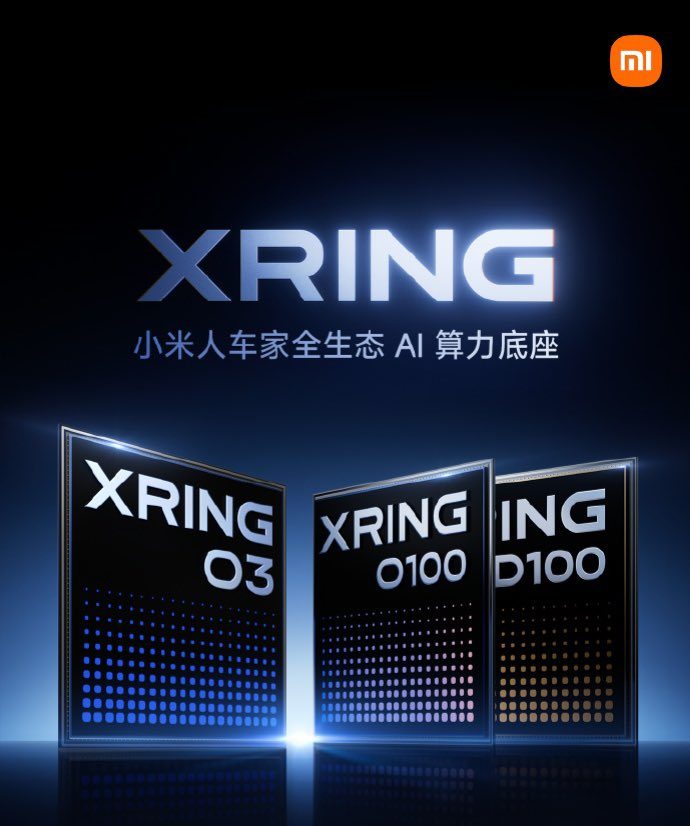
A redesigned four-core NPU delivers a claimed 200 TOPS, while the chip becomes the first smartphone SoC to support LPDDR6 memory, reaching 113.8GB/s of maximum bandwidth. The entire chip contains 24 billion transistors across a 133mm² die manufactured using TSMC’s N3P process.
The XRing O3 will debut in the Xiaomi 18 Fold and Pad 9 Pro Max in September. Reuters reports that Xiaomi continues to develop its own silicon partly to gain more control over critical components and reduce dependence on suppliers such as Qualcomm and MediaTek.