
Daily Guardian UAEDaily Guardian UAE
  • Home
  • UAE
  • What’s On
  • Business
  • World
  • Entertainment
  • Lifestyle
  • Sports
  • Technology
  • Travel
  • Web Stories
  • More
    • Editor’s Picks
    • Press Release
What's On

Dignified Life Launches UAE’s First Life Transitions Advisory

September 7, 2026

Panasonic Develops World’s First PTZ Cameras Featuring a Global Shutter MOS Sensor

September 7, 2026

Marrybrown BurJuman Mall Reopening

September 7, 2026

Loyalty & Reward Co Open Dubai Office as Middle East Loyalty Market Approaches US$5.6 Billion

September 7, 2026

RTA-Yango School Rides Expands as demand increases

September 7, 2026
Facebook X (Twitter) Instagram
Finance Pro
Facebook X (Twitter) Instagram
Daily Guardian UAE
Subscribe
  • Home
  • UAE
  • What’s On
  • Business
  • World
  • Entertainment
  • Lifestyle
  • Sports
  • Technology
  • Travel
  • Web Stories
  • More
    • Editor’s Picks
    • Press Release
Daily Guardian UAEDaily Guardian UAE
Home » Meta’s detection tool fails to identify photos generated by its own Muse Image AI
Technology

Meta’s detection tool fails to identify photos generated by its own Muse Image AI

By dailyguardian.aeJuly 11, 20263 Mins Read
Share
Facebook Twitter LinkedIn Pinterest Email

Earlier this week, Meta announced two new AI products, namely, Muse Image and Muse Video. As the name suggests, these are generative AI tools for making photos and video clips using natural language text prompts. Soon after their rollout commenced, these tools sparked controversy because Meta had automatically opted in Instagram users, allowing others to use their publicly posted media and convert them into remixed AI content. But it appears that Meta courted another loss on its side of the court.

What’s the problem?

Alongside its new AI tools, Meta introduced something called Content Seal, which serves as an invisible watermarking system. Technically, all the images created by the Muse Image AI carry a hidden signal that can be used to identify whether they were made using AI or not. To go with it, the company also launched its own AI identification tool that can read this invisible Content Seal watermark. But it appears that Meta’s AI sniffing tool is not as accurate as the company claims.

According to an analysis by Reuters, images made using the company’s Muse Image AI cannot be reliably detected as AI-generated by Meta’s AI identification software. The outlet analyzed 40 images that were created by Muse Image, but in only 45% of the cases was it able to identify that they were created using AI. In the remaining 55% of the cases, when the images were cropped to one-third or one-fourth of their original size, the AI detection tool developed by Meta simply failed.

Oh, yikes. That’s embarrassing!

That’s a notable flub. On its website, Meta claims that the Content Seal system carries a “hidden provenance signal that stays intact — even when cropped, compressed, resized, or screenshotted.” Following Reuters’ analysis, Meta told the outlet that its AI detection tool is still in preview and that it can’t work reliably when a photo is “heavily cropped.” On an FAQ page available on its AI detector site, Meta also makes it clear that if an image has been generated using a third-party AI product instead of Muse Image, the detection tool will not work.
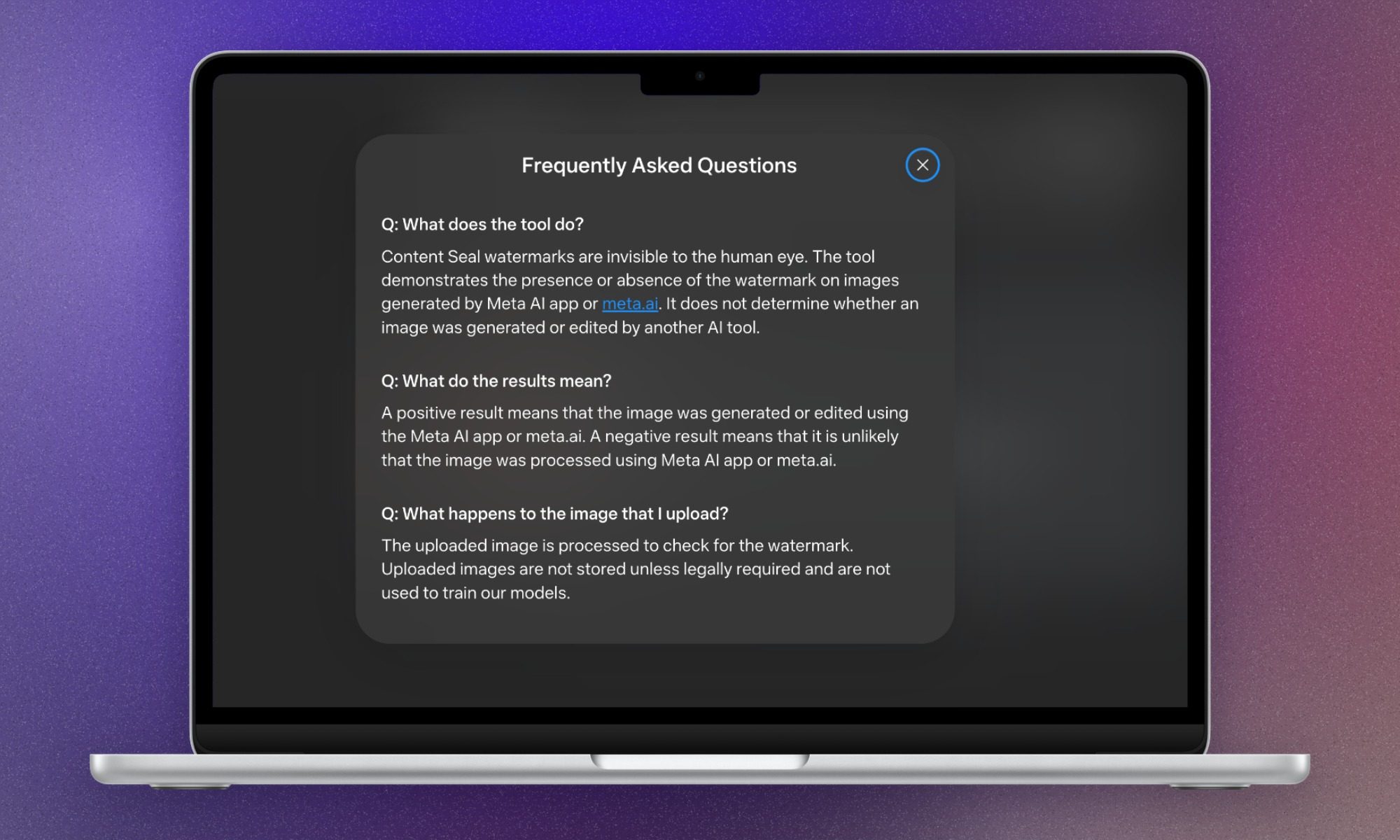
Meta AI identification tool.

Meta won’t be the only AI giant that has created a system like Content Seal. Google already has an AI image detection and watermarking system called SynthID in place. It has been adopted by the likes of OpenAI as well. That means if an image is generated using ChatGPT or Gemini, it carries the invisible SynthID watermark and can be detected using Google’s own AI identification tool, which is now available on Google Search, as well. However, Google also makes it clear that SynthID is not 100% foolproof.

Share. Facebook Twitter Pinterest LinkedIn Tumblr Email

Keep Reading

Lenovo AeroBlade imagines a laptop as thin as a foldable phone, thanks to solid-state cooling

Lenovo puts Nvidia RTX Spark into its new Yoga Pro laptops for local AI at IFA 2026

Motorola’s new Edge 70 Plus packs a 200MP camera and a massive battery

We got GTA VI limited-edition DualSense controllers before GTA VI

Anker unveils smarter chargers and power banks built to fight heat and battery degradation

Anker’s new Soundcore Sleep earbuds can mask snoring and even track your heart rate

TCL P80 series finally marries eye-friendly NXTPAPER tech with an AMOLED panel

Anker’s new MindBase wants to be the brain of your entire home security system

I found 5 cleaning deals worth sweeping up this Labor Day

Editors Picks

Panasonic Develops World’s First PTZ Cameras Featuring a Global Shutter MOS Sensor

September 7, 2026

Marrybrown BurJuman Mall Reopening

September 7, 2026

Loyalty & Reward Co Open Dubai Office as Middle East Loyalty Market Approaches US$5.6 Billion

September 7, 2026

RTA-Yango School Rides Expands as demand increases

September 7, 2026

Subscribe to News

Get the latest UAE news and updates directly to your inbox.

Latest Posts

SAFEEN Drydocks Expands Ship Repair Capacity with UAE’s Largest Floating Dock

September 7, 2026

India’s Odisha State targets export-led industrial growth through high-level UAE investment outreach

September 7, 2026

Inspired by Life, Powered by AI: TCL Redefines Everyday Experiences at IFA 2026

September 7, 2026
Facebook X (Twitter) Pinterest TikTok Instagram
© 2026 Daily Guardian UAE. All Rights Reserved.
  • Privacy Policy
  • Terms
  • Advertise
  • Contact

Type above and press Enter to search. Press Esc to cancel.