
Daily Guardian UAEDaily Guardian UAE
  • Home
  • UAE
  • What’s On
  • Business
  • World
  • Entertainment
  • Lifestyle
  • Sports
  • Technology
  • Travel
  • Web Stories
  • More
    • Editor’s Picks
    • Press Release
What's On

A Modern Lebanese Deli isarriving on Sheikh Zayed Road

September 8, 2026

Dignified Life Launches UAE’s First Life Transitions Advisory

September 7, 2026

Panasonic Develops World’s First PTZ Cameras Featuring a Global Shutter MOS Sensor

September 7, 2026

Marrybrown BurJuman Mall Reopening

September 7, 2026

Loyalty & Reward Co Open Dubai Office as Middle East Loyalty Market Approaches US$5.6 Billion

September 7, 2026
Facebook X (Twitter) Instagram
Finance Pro
Facebook X (Twitter) Instagram
Daily Guardian UAE
Subscribe
  • Home
  • UAE
  • What’s On
  • Business
  • World
  • Entertainment
  • Lifestyle
  • Sports
  • Technology
  • Travel
  • Web Stories
  • More
    • Editor’s Picks
    • Press Release
Daily Guardian UAEDaily Guardian UAE
Home » NASA built the Roman Space Telescope to study dark matter, but it can also help protect Earth from killer asteroids
Technology

NASA built the Roman Space Telescope to study dark matter, but it can also help protect Earth from killer asteroids

By dailyguardian.aeAugust 6, 20262 Mins Read
Share
Facebook Twitter LinkedIn Pinterest Email

NASA is about to launch a telescope built to unlock some of the universe’s biggest mysteries, and it turns out that same design could help protect Earth along the way.

The Nancy Grace Roman Space Telescope is set to launch from Kennedy Space Center on August 30, 2026, with a primary mission focused on studying dark matter and dark energy – the invisible forces shaping galaxies and cosmic expansion. Researchers now say its unique design also makes it unexpectedly effective at spotting dangerous asteroids headed our way (via MIT Technology Review).

What makes the Roman Telescope capable of hunting killer asteroids?

Roman carries a super wide-angle, 300 megapixel infrared camera capable of viewing a section of sky roughly 100 times larger than what the Hubble Space Telescope can see in a single glance. That massive field of view, meant for surveying galaxies and distant stars, happens to work just as well for scanning large stretches of space for asteroids at once.
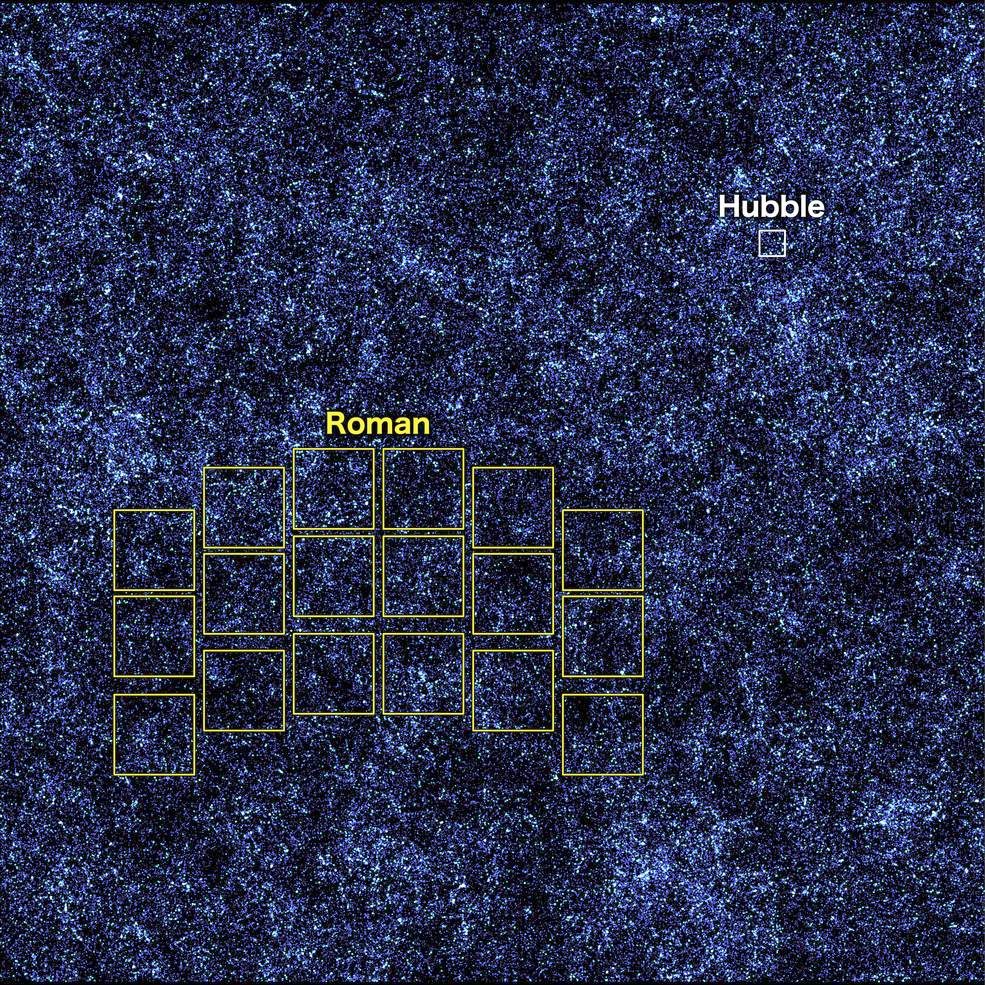
This image, containing millions of simulated galaxies strewn across space and time, shows the areas Hubble (white) and Roman (yellow) can capture in a single snapshot. It would take Hubble about 85 years to map the entire region shown in the image at the same depth, but Roman could do it in just 63 days. Roman’s larger view and fast survey speeds will unveil the evolving universe in ways that have never been possible before.

Scientists say Roman could detect asteroids as small as 60 feet across, a size comparable to the asteroid that exploded over Chelyabinsk, Russia in 2013, releasing energy equal to 500,000 tons of TNT. Some software adjustments are still needed, since Roman’s system currently filters out streaks in images that could actually be asteroids.

The Roman Telescope will be a part of Earth’s defense team

roman-telescope

Roman telescope won’t lead asteroid hunting efforts alone. NASA’s dedicated Near-Earth Object Surveyor, launching in 2027, will lead detection efforts. Roman will support it alongside the James Webb Space Telescope and the Vera Rubin Observatory. When other telescopes flag risky asteroids with uncertain orbits, Roman’s massive field of view can quickly narrow down their paths. That helps scientists decide which asteroids truly need closer study.

The timing is also notable, since Roman faced funding cut threats last year, and researchers say showcasing its planetary defense value could help secure its future with lawmakers. With over half of the largest near-Earth asteroids still undiscovered,Roman’s unplanned second job might end up being just as important as its first.

Share. Facebook Twitter Pinterest LinkedIn Tumblr Email

Keep Reading

Lenovo AeroBlade imagines a laptop as thin as a foldable phone, thanks to solid-state cooling

Lenovo puts Nvidia RTX Spark into its new Yoga Pro laptops for local AI at IFA 2026

Motorola’s new Edge 70 Plus packs a 200MP camera and a massive battery

We got GTA VI limited-edition DualSense controllers before GTA VI

Anker unveils smarter chargers and power banks built to fight heat and battery degradation

Anker’s new Soundcore Sleep earbuds can mask snoring and even track your heart rate

TCL P80 series finally marries eye-friendly NXTPAPER tech with an AMOLED panel

Anker’s new MindBase wants to be the brain of your entire home security system

I found 5 cleaning deals worth sweeping up this Labor Day

Editors Picks

Dignified Life Launches UAE’s First Life Transitions Advisory

September 7, 2026

Panasonic Develops World’s First PTZ Cameras Featuring a Global Shutter MOS Sensor

September 7, 2026

Marrybrown BurJuman Mall Reopening

September 7, 2026

Loyalty & Reward Co Open Dubai Office as Middle East Loyalty Market Approaches US$5.6 Billion

September 7, 2026

Subscribe to News

Get the latest UAE news and updates directly to your inbox.

Latest Posts

RTA-Yango School Rides Expands as demand increases

September 7, 2026

SAFEEN Drydocks Expands Ship Repair Capacity with UAE’s Largest Floating Dock

September 7, 2026

India’s Odisha State targets export-led industrial growth through high-level UAE investment outreach

September 7, 2026
Facebook X (Twitter) Pinterest TikTok Instagram
© 2026 Daily Guardian UAE. All Rights Reserved.
  • Privacy Policy
  • Terms
  • Advertise
  • Contact

Type above and press Enter to search. Press Esc to cancel.