
Wearable health trackers have become smaller, smarter and more capable over the years, but they’ve also remained surprisingly… boring. Whether it’s a smartwatch, a chest strap or a sticky ECG patch, most health sensors still rely on bulky hardware that can peel off, irritate the skin or become less accurate once you start sweating. Additionally, there is a shift of technology from plastic wearables/trackers to clothes, which seemingly do the same thing as well. But that is not the story today.
Researchers at Penn State think they’ve found a far more elegant solution. Instead of sticking another sensor onto your skin, why not simply paint one?
The team has developed a conductive ink that can be brushed directly onto the skin like temporary body paint, transforming almost any design into a functioning health monitor. The colourful tattoos don’t just look more fun – they’re also capable of tracking electrical activity from the heart, muscles and brain with impressive accuracy. The research has been published in the Proceedings of the National Academy of Sciences (PNAS).
A tattoo that works like a medical sensor
The technology revolves around a specially formulated water-based conductive ink that behaves much like face paint. While wet, it has a glue-like consistency. After being applied to the skin, it dries in under ten minutes – or even faster with the help of a hair dryer—and becomes a functional electrode capable of reading the body’s electrical signals.
Unlike conventional wearable sensors, these electrodes aren’t manufactured in a factory and then attached to the body. They’re created directly on your skin.
That seemingly simple difference solves one of the biggest problems with today’s wearable medical sensors. Traditional electrodes often leave tiny air gaps between the skin and the sensor, particularly on hairy or sweaty skin. Those gaps reduce signal quality and can cause readings to become unreliable during movement. By painting the electrode directly onto the skin, the conductive ink conforms to every contour, dramatically improving contact and signal accuracy.
The researchers demonstrated that the tattoos could continuously record ECG signals to monitor heart activity, EEG signals for brain activity, and EMG signals that measure muscle contractions. In one demonstration, the team even used muscle signals from a participant’s forearm to wirelessly control a robotic prosthetic hand. The tattoos also remained attached during exercise and continued recording accurate heart activity throughout a 12-hour test involving everyday activities.
Medical-grade wearables don’t have to look medical
Perhaps the most unexpected part of the project is that the sensors aren’t designed to look clinical at all. The ink starts nearly transparent but can be mixed with ordinary food colouring, allowing users to create almost any design they like. Researchers even suggest painting cartoon characters or superhero logos onto the skin instead of wearing conventional medical patches.
It’s a clever way of making healthcare technology less intimidating – particularly for children who often dislike adhesive electrodes used during hospital visits. The tattoo itself is only one part of the system. A small section of the painted electrode connects to a stretchable silver textile that acts like a conductive fabric before linking wirelessly to a reusable electronics module worn underneath clothing. That module transmits data to a computer over Bluetooth.
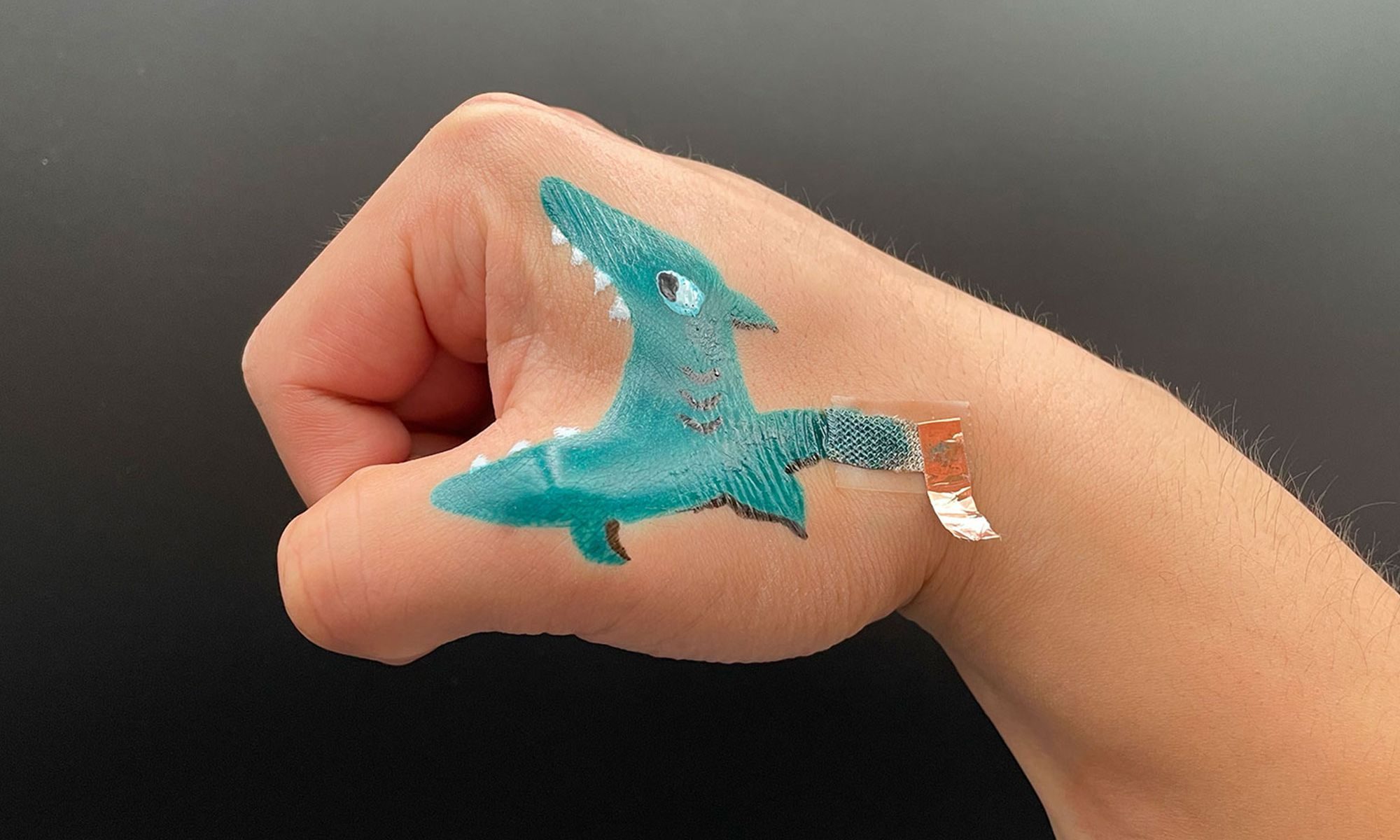
The electrode material itself is surprisingly durable. Thanks to its porous structure, it can stretch to more than 150 percent of its original size while allowing sweat and moisture to pass through instead of becoming trapped underneath the skin. That not only improves comfort but also helps prevent irritation during long-term wear.
When it’s no longer needed, the tattoo simply washes off with water. Another one can then be painted on within minutes, while the more expensive electronic module continues to be reused. The researchers have already filed a provisional patent for the technology and believe its potential extends well beyond wearable health tracking. Future versions could monitor biomarkers such as glucose or cortisol, opening the door to more advanced continuous health monitoring. The team is also exploring applications in agriculture, where similar paint-on sensors could transform ordinary plants into “smart plants” capable of detecting environmental chemicals and reporting on their own health.
It sounds almost futuristic – a tattoo that monitors your body, controls a robotic hand, and disappears when you’re done with it. Yet that’s exactly the future Penn State’s engineers are trying to paint, one brushstroke at a time.